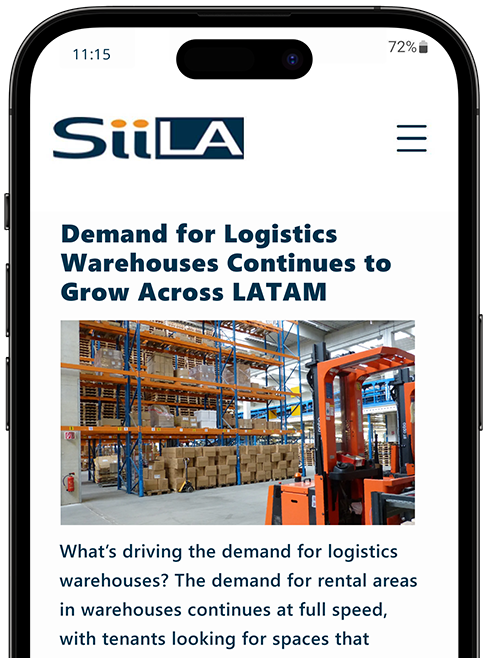
Industry Is Changing Mexico City’s Map. Here’s How It’s Happening
- E-commerce is driving new uses of industrial space in Mexico City, while traditional industrial corridors continue to expand.


Since 2020, four Mexico City boroughs have appeared in SiiLA’s industrial real estate inventory for the first time. Coyoacán, Iztacalco, Cuajimalpa and Benito Juárez, which had no properties in this category at the beginning of that year, now account for 72,725 square meters. And in 2027, Xochimilco could become the fifth.
Behind this expansion are companies—such as Amazon, Jüsto, and Mercado Libre—that need to distribute goods within the city itself, as well as real estate developers seeking to repurpose underutilized spaces for new logistics operations. Property conversions are also happening in boroughs with established industrial activity, such as Iztapalapa, where ProximityParks recently announced a 600 million peso investment to transform a former, abandoned office furniture factory into a last-mile logistics park spanning more than 24,000 square meters. The project, known as ProximityParks Iztapalapa III, aims to bring distribution operations closer to consumers in eastern Mexico City.
The emergence of new industrial spaces is part of a broader expansion of the capital’s industrial real estate market, with inventory within city limits growing 25% between early 2020 and the third quarter of 2026, from nearly 950,000 to approximately 1.2 million square meters. However, growth was not uniform throughout the period. In fact, 72% of the new space was delivered starting in 2024, after four years when deliveries averaged just 16,000 square meters annually.

Part of this shift coincides with the expansion of e-commerce and the diversification of last-mile distribution models, which require facilities capable of supporting deliveries within increasingly shorter time frames. In this context, proximity to consumers matters more, and SiiLA data shows that between 2020 and the third quarter of 2026, digital fulfillment companies accounted for 26% of identified industrial absorption across the city’s boroughs, followed by transportation and logistics companies at 17%.
Industry Is Also Growing Where It Was Already Established
However, the emergence of new industrial buildings in other parts of the city has not halted growth in traditional industrial corridors. Azcapotzalco, for example, retains the capital’s largest inventory, with more than 622,000 square meters, accounting for just over half of the total, after growing 9% since 2020. Gustavo A. Madero, meanwhile, nearly doubled its industrial space over the same period, from approximately 80,000 to more than 162,000 square meters, and currently accounts for 61% of the nearly 91,000 square meters under development in Mexico City.

Proximity Comes at a Price
However, establishing operations within the capital comes at a higher cost. According to SiiLA, in 2026, average asking rents for industrial properties within the city’s boroughs reached $14 per square meter per month, compared with $9.90 in the rest of the metropolitan industrial market, which includes areas of the State of Mexico and Hidalgo. In other words, companies seeking space within the capital face prices 41% higher, although vacancy rates are lower at 3.6% compared with 4.3% outside city limits.
Taken together, these changes reveal two approaches to industrial investment in Mexico City. On one hand, traditional corridors allow for larger-scale developments in areas where industrial activity is already established. On the other, new locations offer opportunities to bring operations closer to consumers through smaller buildings, even in areas where no institutional industrial inventory had previously been recorded.
These approaches also show up in the profiles of companies occupying the properties. While new locations primarily attract e-commerce-related activities, demand in the northern industrial corridors is more diverse, with companies involved in transportation, logistics, food production, pharmaceuticals and electronics. Further west, industrial buildings also house clothing, accessories, and medical device companies, some of which occupy units as small as 150 square meters.
The capital’s industrial growth thus reveals a changing relationship between economic activity and urban space. Want to learn what other changes are taking shape in this and other markets? Visit SiiLA Market Analytics or email us at contacto@siila.com.mx.