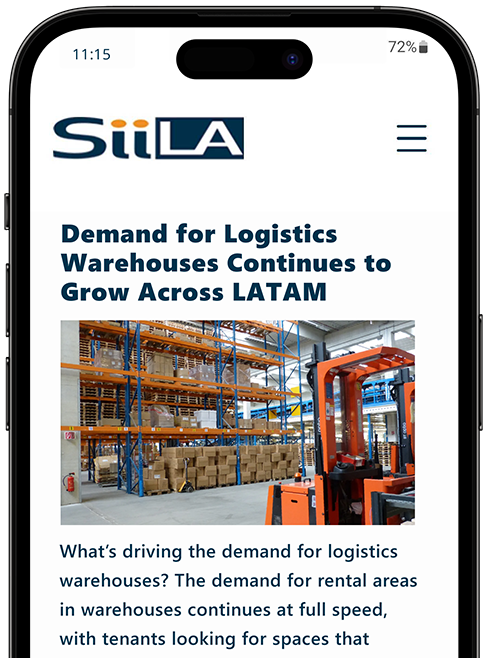
Vertical Designs and Ceilings Up to 20 Meters: Industrial Warehouses in Mexico
- In Mexico, industrial warehouses average ceiling heights of 10 meters, though only 15% exceed that figure. This trend, however, is evolving. Factors such as nearshoring, the increasing complexity of supply chains, and the scarcity of industrial-zoned land drive innovative designs, from higher ceilings to vertical warehouses in key markets. How is the industry addressing these challenges, and what strategies are shaping the sector’s future? This article explores the trends redefining Mexico’s industrial real estate landscape.


Did you know that industrial warehouses in Mexico have average ceiling heights of nine to ten meters, depending on the sector and market? Some, however, take design to a whole new level. Properties like Litos-Negra Modelo in the State of Mexico reach 20 meters in height, while certain warehouses in Guadalajara’s Poniente Industrial Park rise to 17 meters.
These exceptions—representing just 15% of Mexico’s industrial inventory with ceilings above 10 meters—are only the tip of the iceberg. Ceiling heights in industrial warehouses reflect regional dynamics, logistical needs, and the sector’s ability to balance design, functionality, and profitability.
More vertical space means greater storage capacity, flexibility for complex logistics systems, and, when well-utilized, improved operational efficiency. Yet, height has limits: building higher increases costs, requires more advanced ventilation and climate control systems, and risks wasting space if not fully utilized.
But what do ceiling heights reveal about Mexico’s industrial real estate market? A SiiLA analysis of nearly 2,000 properties shows that size, location, and function are key to understanding how—and why—ceiling heights vary.
In industrial warehouses, size tends to increase in all dimensions. Smaller warehouses, up to 10,000 square meters, typically feature ceilings around 8.5 meters. Medium-sized properties, between 10,000 and 50,000 square meters, average nine to ten meters. Larger facilities, those exceeding 50,000 square meters, often boast ceilings over 10 meters. However, this is not a hard rule: smaller warehouses designed for specific operations can have remarkable heights, while some larger facilities prioritize other aspects over vertical space.
The Litos-Negra Modelo warehouse exemplifies this dynamic, with a gross leasable area (GLA) of just 3,000 square meters but a ceiling height of 20 meters, tailored for last-mile operations. In contrast, Warehouse Five at the Tulti Park I complex spans more than 130,000 square meters with a more modest height of around 10 meters, designed for traditional logistics needs.
The purpose of a warehouse also shapes its design. Those dedicated to logistics lead with average ceilings of 9.5 meters, followed by manufacturing at 8.1 meters, and last-mile facilities, which prioritize location over height, at 7.5 meters.


The location also reveals intriguing regional trends. In central Mexico, a market dominated by logistics and last-mile facilities, warehouses have the highest average ceilings, nearly 10 meters. The Bajío and Northeast regions follow, with a mix of logistics and heavy manufacturing featuring nine-meter ceilings. The Northwest, dominated by manufacturing, rounds out the list with average heights of just over eight meters.
In Mexico, industrial warehouses have historically expanded outward, except in areas where land or infrastructure is constrained, such as Tijuana or central Mexico City, where limited space has driven the development of vertical warehouses. Once an exception, this solution is poised to become a long-term trend. Nearshoring, increasingly complex supply chains, and a closer commercial relationship with the U.S. are reshaping the landscape. Industrial-zoned land is becoming scarcer, not only due to spatial constraints but also because of permitting challenges and infrastructure demands. Verticality, far from being a novelty, is emerging as a vital strategy to maximize space and meet market demands that prize efficiency, ingenuity, and sustainability.
Want to learn more about Mexico’s industrial real estate market? Explore SiiLA REsource and stay updated with the most relevant industry news. For more information, contact us at contacto@siila.com.mx.